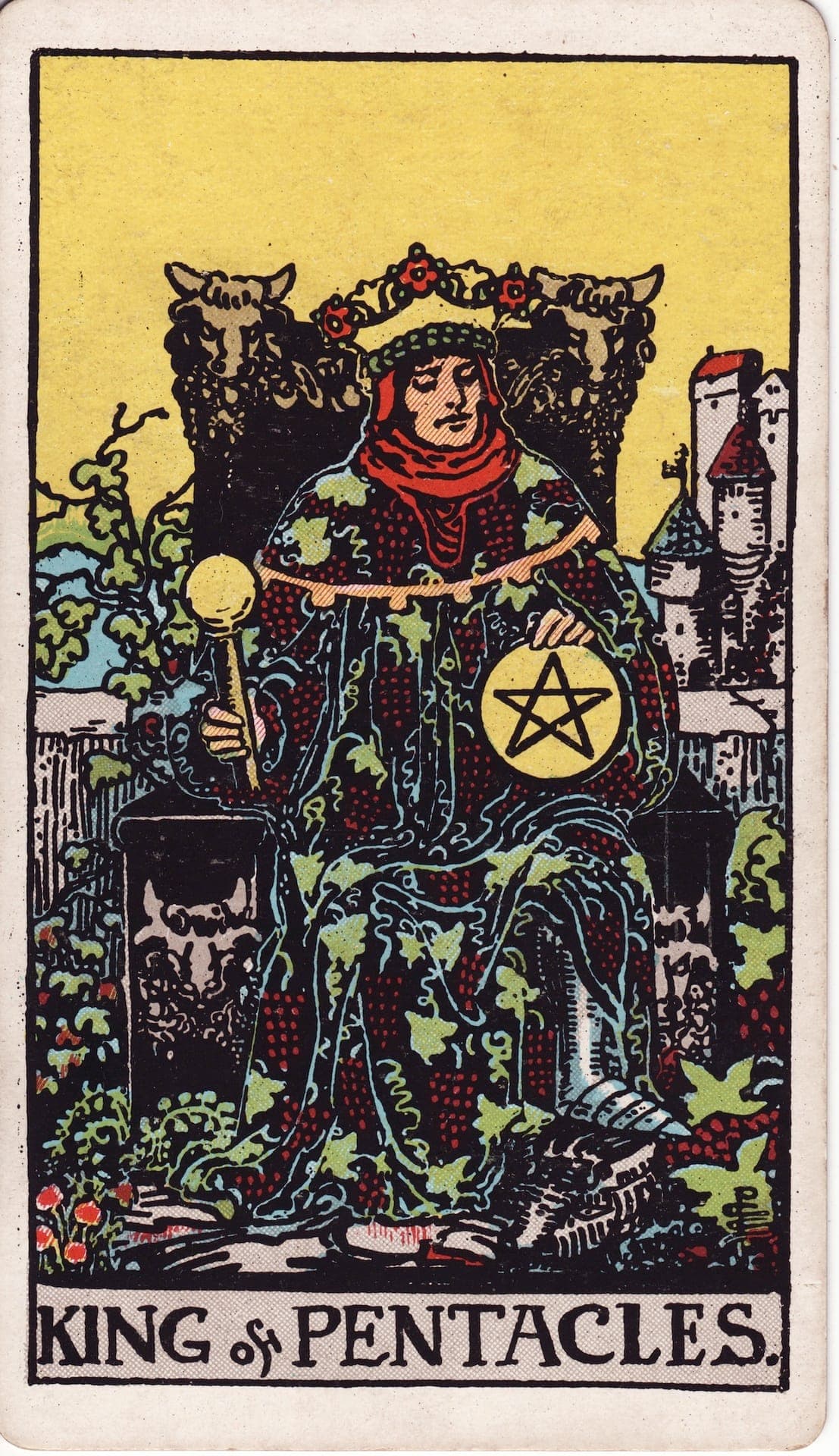
King of Pentacles
The ultimate provider and business leader who creates lasting security and abundance through discipline and practical wisdom.
wealthbusinessstabilitydisciplineprovidersuccessreliability

Featured Talk
How to Build a Company Where the Best Ideas Win
Ray Dalio
201716 min
“Ray Dalio’s talk maps to the King of Pentacles because it is about building durable, compounding prosperity through a disciplined culture of truth, clear incentives, and repeatable decision systems. The “best ideas win” approach is stewardship: turning reality-based thinking into stable outcomes that can scale beyond any single person.”
▶READ MORE ABOUT WHY THIS MAPPING...
The King of Pentacles is the archetype of sustainable success, the kind that holds up under pressure, keeps paying dividends, and does not depend on charisma or luck. This card is not primarily about flash, disruption, or inspiration. It is about building an environment where value is created reliably, protected intelligently, and grown over time. Dalio’s talk is a blueprint for that kind of grounded power. He is not arguing for a single clever strategy, he is describing how to design the operating system of a company so that good judgment becomes the default and poor judgment becomes harder to hide. That is King of Pentacles energy: pragmatic, structured, results-oriented, and deeply concerned with what works in the real world.
A central Pentacles theme is that outcomes are shaped by systems. The King of Pentacles builds systems that outlast mood, ego, and circumstance. Dalio’s emphasis on radical truth and radical transparency fits this exactly because it treats truth as an asset and self-deception as a liability. In a King of Pentacles company, politics are seen as waste, unspoken tension is seen as a hidden cost, and unclear standards are seen as risk exposure. The talk’s focus on creating a culture where people can challenge each other, surface mistakes, and examine thinking without collapsing into personal drama is essentially financial hygiene applied to human behavior. It is the same instinct as keeping clean books, maintaining equipment, and inspecting the foundation before you add another floor.
The “best ideas win” claim also maps to Pentacles because it is a compounding engine. If you can repeatedly make slightly better decisions, the gains stack across hiring, product choices, resource allocation, and strategy. The King of Pentacles understands compounding at a gut level and designs for it. That is why Dalio talks about principles as something you operationalize, not something you merely believe. When principles become repeatable practices, decision rules, and feedback loops, they turn into infrastructure. Infrastructure is the King’s domain. It is the difference between having a great season and having an enduring enterprise.
There is another subtle King of Pentacles signal here: the shift from status-based authority to credibility-based authority. The King of Pentacles does not just want confidence, he wants demonstrated competence. In Dalio’s framework, decision-making weight is earned by track record and domain expertise rather than title alone. That is a very Pentacles way to run power, like investing resources where they are most likely to produce returns. It is also how you reduce risk. You do not bet the farm on the loudest voice, you bet on the most reliable signal. Over time, that creates stability, and stability is one of the King’s primary promises.
Finally, this talk is King of Pentacles because it frames culture as a material force. Culture is not a poster on the wall, it is the mechanism that determines how decisions actually get made when it is messy, uncomfortable, and high-stakes. Dalio is describing how to build a culture that can metabolize disagreement into better choices, turn mistakes into learning, and keep the organization oriented toward reality. That is stewardship at scale. It is the King of Pentacles building an estate where the harvest is not accidental, and where prosperity is the natural result of disciplined truth, clear structure, and compounding good judgment.
Other archetypes showing up in this talk: Justice, The Hierophant, The Emperor, King of Swords, Judgement, Temperance, The Magician, The Chariot
Shared on8mo