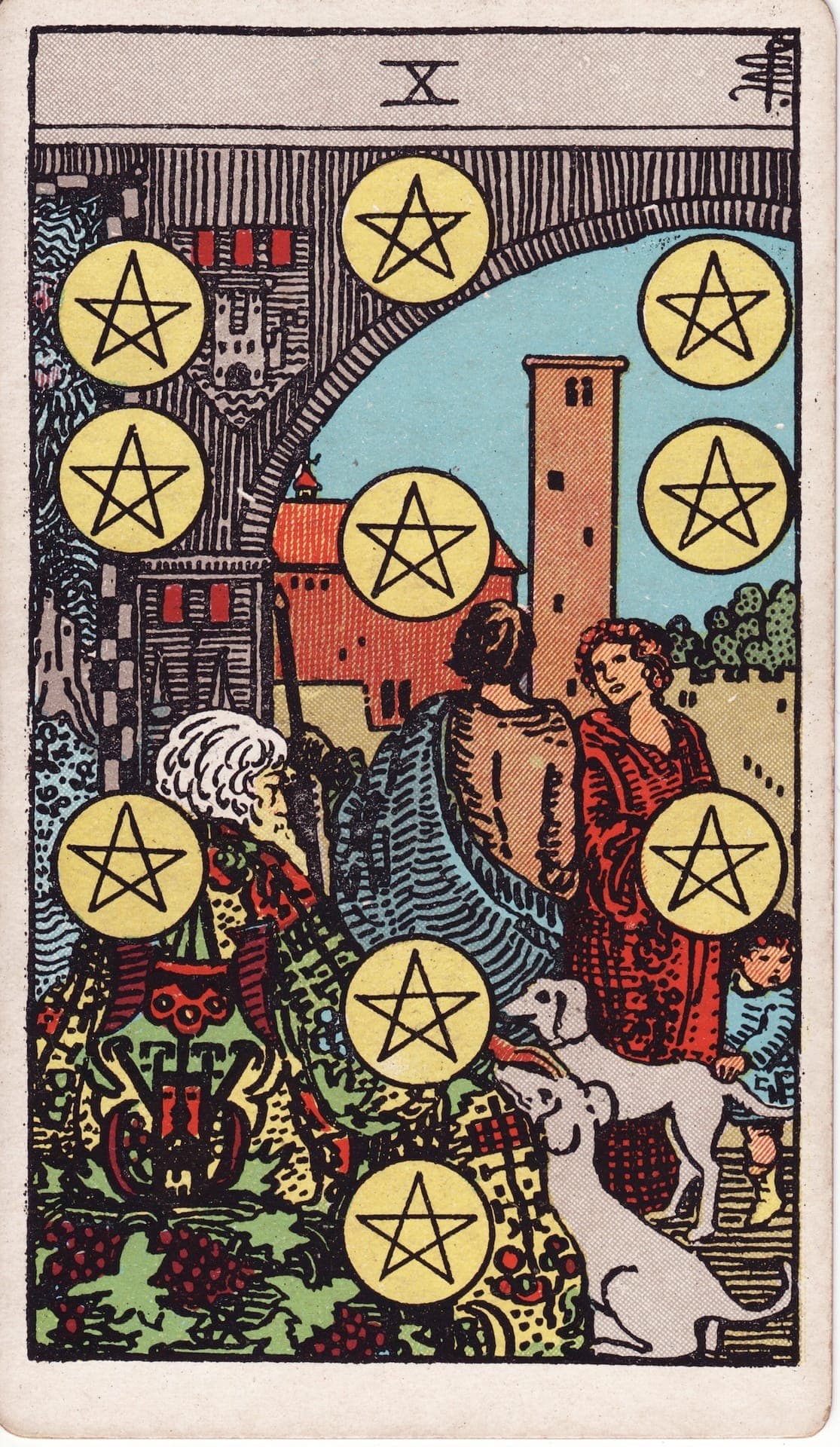
Ten of Pentacles
The culmination of material success manifested as long-term stability, family legacy, and intergenerational wealth.
legacywealthfamilytraditionpermanenceinheritancedynasty

Featured Talk
What Baby Boomers Can Learn from Millennials at Work -- and Vice Versa
Chip Conley
201812 min
“This talk maps to the Ten of Pentacles because it is fundamentally about building a workplace where value travels across generations and becomes durable. Chip Conley frames age diversity as an asset that can be designed for, so that institutional memory, relational wisdom, and long-view stewardship can pair with speed, digital fluency, and new cultural instincts. The result is a richer kind of prosperity that shows up as stronger culture, better outcomes, and continuity that can outlast any single cohort.”
▶READ MORE ABOUT WHY THIS MAPPING...
The Ten of Pentacles speaks to legacy, intergenerational continuity, and the kind of wealth that is measured in systems that endure: families, institutions, cultures, and the invisible agreements that let a community thrive over time. This talk’s central move is to treat the workplace as a living lineage, where different age groups carry different forms of capital, and the organization gets healthier when those forms of capital circulate. Conley’s “modern elder” framing is especially Ten of Pentacles, because it positions experience as an active resource that becomes more valuable when it is shared in ways that fit the present. He is describing a new social architecture at work, one where elders are not pushed aside and younger people are not dismissed, and where respect is operationalized through reciprocal mentorship.
A Ten of Pentacles company is not optimized only for the quarter, it is optimized for the next chapter. That is what the talk is trying to install. It asks leaders to design roles, language, and norms that make cross-generational exchange normal rather than exceptional. It also highlights that millennials are not simply “junior workers,” they are carriers of emerging values, new collaboration patterns, and a different relationship to technology and meaning. Meanwhile baby boomers carry context, pattern recognition, and a practiced sense of how to navigate complexity over decades. When those assets are invited into the same room with shared dignity, the organization gains compounding returns: fewer repeated mistakes, higher trust, better mentorship pipelines, and a culture that can metabolize change without losing its center.
The Ten of Pentacles is also a card of belonging, because it implies a community where people can locate themselves in a larger story. This talk offers a way for people of different ages to feel that they have a seat at the table and a role in the shared inheritance of the organization. It reframes the workplace as a place where meaning and mastery can deepen across time, where mentoring runs both directions, and where the success of the enterprise is strengthened by continuity of wisdom, values, and care. In that sense, the talk is less about fixing a generational “problem” and more about creating a legacy-minded ecosystem where the whole community prospers.